What a great weekend.
This past weekend EWB was invited to attend the UC Sustainability Summit. Kelsey Reichenbach, Sam Zogheib, Evan Saunders, Blake Beard, and myself all represented EWB at the summit. The event occurred at General Butler State Resort Park in Kentucky. So many student groups were present at the Summit. Students for Ecological Design (SED), Mountaineering Club (UCMC), DAAP Cares, Real Food Challenge, Greek Life, Leaders for Environmental Awareness and Protection (LEAP), and of course, UC Sustainability, all had representatives at the summit. So, lets get down to what transpired over this great weekend.
The summit began on Friday evening with some icebreakers and group building activites, so that everyone could get to know each other. After the icebreakers, the group wrote down the ground rules for the summit. They were your basic rules you want for a summit of this nature: keep an open mind, respect others, hugs/respect personal space, you get the idea. After that, we went to dinner at Two Rivers Restaurant. The buffet was AMAZING! So many foods to choose from, each one better than the next.
The group building activity after dinner was for groups of eight to create a three minute commercial. So many funny commercials were created using random props given to each group. A hockey playing Barack Obama approving a miniature Old Spice deodorant spray can, using records to bring the dead back to life while Nicholas Cage stole the Declaration of Independence to try and help, and a few more funny commercials got the summit off to a great start.
The guest speakers for the night were Mary Beth McGrew from UC Planning, Design, and Construction and Joe Harrell from UC Utilities spoke to the group about sustainability efforts at UC. Mary Beth discussed LEED Certification of buildings at UC, and the efforts of UC to incorporate sustainable practices in new buildings being built around UC. Joe Harrell was there to talk about the efforts that Utilities has gone to to reduce UC's carbon footprint. The main issue discussed was the coal power plant that is currently being operated on medical campus. He talked about other options that UC is looking into to power the boilers. The main source that was discussed was the use of fuel pellets to operate the boilers. These fuel pellets would drastically reduce the carbon emissions of the plant. The only downside is that fact that the pellets have to be shipped all the way from Green Bay, Wisconsin. So, UC has been talking to local business to drum up support for a plant to create these pellets to be constructed near Cincinnati. Read more about the pellets and the power plant here.
The summit then went into brainstorming mode. Everyone divided into multiple groups and wrote down any ideas they had about sustainability at UC. The goal is to present the top five goals the sustainability summit wants to see implemented at UC by the Bicentennial in 2019. A lot of great ideas were thrown around, including solar panels, using gym equipment at CRC to generate electricity, water bottle refill stations being set up around campus, more green roofs/beautification and so many other great ideas were mentioned. The entire list was posted on the walls, and everyone got five votes to vote for there favorites (there were around 35 ideas listed).
To end the night the group went down to the camp grounds and had a bonfire. S'mores were made, and everybody was able to mingle and get to know one another. The bonfire was a great way to relax to get ready for an event filled Saturday.
Saturday started off with yoga in the morning at 7am (for those that actually woke up, aka not me). Breakfast was at 8, and then the summit got into productivity mode a little after 9. The morning session was identifying the problem. Everybody divided up into their respective student groups and sat down to discuss the problem their student group want to tackle. For EWB, that problem was fundraising/marketing for the Nyambogo Project. Fundraising and marketing have been the areas EWB-UC really needs to improve upon because, let's face it, we are engineers. We want to design things and build them. We aren't always the most social or verbal bunch you will ever meet (we are working on it, OK?!). But we can't just ignore fundraising and marketing hoping we get that one big donation that gives us what we need to finish the project. So, as a group we outlined what we need to do to market the fundraising campaign and make it successful. We divided it up into four categories: marketing, events, donors, and grants. We then discussed all the different aspects of each category, and Saturday was off to a fantastic start.
The summit then moved into student skill sessions. The topics in these sessions talked about grant writing, delegating tasks, transition of power from class to class, being an effective leader, and a large variety of other topics. Each person had chosen four different skill sessions to attend when they filled out the application to attend the summit (there were 12 to choose from). These lasted about 25 minutes per session, and offered great ideas to implement.
After lunch it was time to listen to the guest speakers. There were four speakers total, and each student could pick two speakers to listen to. The speakers that attended the summit were Mark Fisher from the Cincinnati Zoo, Jim Schenk from Enright Ridge Urban Ecovillage, Ramsey Ford from Design Impact, and Kathyrn Lee from Environment Ohio. I attended the Enright Ridge and Design Impact sessions, and each offered there own insights into sustainability and its role in this world. Enright Ridge is an ecovillage located in Price Hill here in Cincinnati. The purpose of the ecovillage is to provide the opportunity to live in a connected community that explores alternative energy while still being in the heart of the city. Design Impact is a local non-profit organization that works in developing nations to provide solutions to various social needs. They have designers partner with entrepreneurs and communities to find solutions to these issues. Both speakers where highly engaging, and each got me thinking of new ways to approach sustainability.
After the speakers, we moved onto laughing yoga. Alex lead the group in laughing yoga, which was a fantastic way to unwind and recharge for the next round of activities. Laughing yoga was not like regular yoga with the stretching and contortionists positions. It was about the unwinding aspect that yoga provides. The entire time Alex had the group laughing as hard as they can, throwing around "laughter balls", and trying to form a circle with everyone sitting on each others lap.
We next moved into session two: resources. Here we discussed all the resources that our group has at their disposal. We determined that EWB has the following resources: technical knowledge out the wazoo, partnerships (with EWB-USA, VLOP, and SHED), our alumni, our mentors, and a few other things (there was a lot of info being thrown around, I couldn't remember everything). We also had a contest to build a balloon tower (sound familiar?). We divided into four groups, and I am proud to say that my group won (kind of helps when you have an engineer who wants to design structures), but it was a very close race. After the second session we broke for dinner.
After dinner we started off with team rock-paper-scissors. The way it works is if you lose the match, you have cheer for the person who beat you for as long as they are winning. If they lose, you then start cheering for the person who beat them and so on. This was a surprisingly quick competition only lasting a minute or two.
The third session for the day was planning for execution. The purpose for this was to further expand on the ideas generated in the previous sessions. A large interconnected web chart was created to outline all the tasks that would go into a specific topic. We choose to focus on the restaurant fundraiser we want to put on over the course of the year. We outlined where they could take place, the different tasks that would be necessary to execute the plan, and they various jobs people would have to take on the get the job done. We came up with a lot of good ideas, and now know of a lot of things that new members can help with to feel more involved with EWB.
After the third session, everyone headed back down to the campground for another bonfire. At the bonfire everyone went around and acknowledge someone or something that they liked that occurred during the days activities. The bonfire was a great way to relax before heading off to bed.
The next day started off again with morning yoga, and then moved into breakfast and packing up the car. The final session for the summit was about reflection on the summit and preparation. Each group was then given the opportunity to present the different ideas they had for their organizations problems. We talked about how we want to approach the problem of fundraising for Nyambogo. We first want to make an emotional connection with potential donors, and then use this connection to pitch the water project without getting into the technical details of the project.
The summit ended with a picture and a group hug, and that concluded the events of a fantastic weekend.
The Sustainability Summit was a great event to attend. We had the chance to meet other leaders of student groups who are as passionate about sustainability as we are, as well as make a lot of new friends. I highly recommend that every member of EWB try and attend the summit at least once before they graduate.
A big shout out to Charles Marxen, Ryan Ponti-Zins, and the rest of UC Sustainability who put together such a wonderful summit. My only wish is that I could have experienced the summit before I entered my senior year.
(Sorry for not having any pictures. I was too involved to remember to take any with my camera)
One more thing, make sure you vote for EWB-UC in the Penetron Contest!
https://www.facebook.com/ThePenetronGroup?sk=app_278465152274055

Showing posts with label partnership. Show all posts
Showing posts with label partnership. Show all posts
Tuesday, October 29, 2013

Tuesday, September 10, 2013
Now Where Were We...
Hello again everyone!
It has been quite a while since we have sent out an update, and we have a lot of stuff to talk about.
The last time we talked was back in December, right after Richard and myself finished the third implementation trip to Burere. There has been a lot of activity in Burere in the last 9 months, so that is where we will begin our journey. Upon the restart of classes in January, we started to plan our next implementation trip in April/May to put the roof on the school (if you don't remember, the concrete ring beam was put into place in December). We once again turned to Richard Elliott to guide us through the process of how to build the trusses and put the roof on the building. Richard was traveling back to Tanzania in March with Dr. Michael Zaretsky of VLOP and some students from UC. The plan was for Richard to create a mock-up of one of the trusses, so that when the implementation crew arrived in April, a "cookie cutter" pattern of the truss would be ready to be used and streamline construction of the roof. Richard was successful in this regard, and sent us a picture of the completed truss.
Yeah, it's pretty big. And 13 of them will be placed on top of the ring beam.
Next big event for Burere was the 4th implementation trip in April. Selected to go on this trip was Justin Thompson, Sean Buchanon, John Wynn, Matthew Menche, Devin Metzger, and Richard Elliot. Unfortunately since I was not on the trip, I can not give you day by day updates on construction. Matt was able to send me some photos of the trip, so those will have to do to describe events that occurred.


We still have a few things left on the school to complete, but since the main structure is complete, EWB-UC will now begin to focus the majority of our attention on raising funds for the Nyambogo Water Project.
A very big thank you to those who have supported us throughout this incredible journey. Jay, Julie, and Jason at THP Limited for there work on the design, Richard Elliott for traveling with every team to build the school and lending us his experience working in the area, Emily Roush Elliott for helping us begin implementation, being there to guide us through the building process, and for letting us steal Richard when we traveled, Dr. Lewis and VLOP for helping us through this long process, and to all the students and faculty at UC who played a part in the Burere Schoolhouse Project. Thank You!
It has been quite a while since we have sent out an update, and we have a lot of stuff to talk about.
The last time we talked was back in December, right after Richard and myself finished the third implementation trip to Burere. There has been a lot of activity in Burere in the last 9 months, so that is where we will begin our journey. Upon the restart of classes in January, we started to plan our next implementation trip in April/May to put the roof on the school (if you don't remember, the concrete ring beam was put into place in December). We once again turned to Richard Elliott to guide us through the process of how to build the trusses and put the roof on the building. Richard was traveling back to Tanzania in March with Dr. Michael Zaretsky of VLOP and some students from UC. The plan was for Richard to create a mock-up of one of the trusses, so that when the implementation crew arrived in April, a "cookie cutter" pattern of the truss would be ready to be used and streamline construction of the roof. Richard was successful in this regard, and sent us a picture of the completed truss.
 |
| Truss built in March |
Next big event for Burere was the 4th implementation trip in April. Selected to go on this trip was Justin Thompson, Sean Buchanon, John Wynn, Matthew Menche, Devin Metzger, and Richard Elliot. Unfortunately since I was not on the trip, I can not give you day by day updates on construction. Matt was able to send me some photos of the trip, so those will have to do to describe events that occurred.
 |
| Construction Team and Kingigoro Students |
 |
| Putting Trusses in place |
 |
| Moving the truss into place |
 |
| Drilling holes for the bolts |
At the end of the trip, all 13 trusses were in place and 2/3 of the roof was complete. Our trusty contractor Julius completed the roof for us over the summer. Then in August we received some pictures of the completed roof. It looks absolutely amazing.


A job well done by all those involved! Then a few weeks later, Rosie sent us a picture of the school, with classes in session! To say we were excited would be the understatement of the year.
 |
| Julius (right) helping to officially open up the school. |
A very big thank you to those who have supported us throughout this incredible journey. Jay, Julie, and Jason at THP Limited for there work on the design, Richard Elliott for traveling with every team to build the school and lending us his experience working in the area, Emily Roush Elliott for helping us begin implementation, being there to guide us through the building process, and for letting us steal Richard when we traveled, Dr. Lewis and VLOP for helping us through this long process, and to all the students and faculty at UC who played a part in the Burere Schoolhouse Project. Thank You!
Thursday, April 14, 2011
A Weekend with Bill Clinton: CGIU 2011


 For all the hard work, Jim and Mark certainly were successful in networking with students and young adults from all over. They look forward to bringing back what they have learned to better serve EWB-UC and the UC community! Of course, not all their time spent was hard at work - San Diego's beach towns capped off the weekend beautifully!
Wednesday, April 13, 2011
A New Tradition: EWBer of the Month!

EWB has started something new and exciting! As of winter quarter, we’ve established EWBer of the Month. EWBer of the Month is chosen by the Exec board and has to be an outstanding member of the group. They must be outstanding in the fact that the work that they are doing is pushing their project, committee, and/or the group as a whole forward.
I am pleased to announce that we have already named two EWBers of the Month. The EWBer of the Month for February was Ryan Deffinger. Ryan has done a great deal with the External Affairs Committee. His work focused on fundraising for EWB on a very personal level and in doing so, he also recruited Dr. Ming Tang, a professor of an Architectural Design course in DAAP, to help revise and provide constructive criticism with the Otho Abwao and Burere schoolhouse schematics and blueprints. Ryan has also been seeking out companies for donations and sponsorship. Through personal connections and donations, Ryan has raised $676 for the group! He plans on continuing, and expanding upon, his efforts. Great job Ryan!
The EWBer of the Month for March is Avdhesh Gaur. As a graduate student from India studying Civil Engineering, Avdhesh is a very crucial member of the Burere Project. He has been working closely with THP and his work on the seismic and wind load calculations for the Burere school is extremely valuable for not only Burere, but for the entire group to use on future projects. Avdhesh has also been working on the structural design of the Burere school - another thing that will be very useful not only for Burere, but for projects to come! Keep the good work coming Avdhesh!
Congratulations again to these two gentleman. Keep up the outstanding work, our group wouldn’t be where it is now without you! Stay tuned for more EWBers of the Month!
Monday, November 22, 2010
Presenting for International Education Week
We broke an international project into four key components that are absolutely necessary
- Partnership: from first impressions to keeping consistent communication, having a strong with the community is crucial to the long-term success of a project
- Logistics: from lodging to travel, food to communication, we gave little tips and tricks for the nitty-gritty details necessary to get you through the trip safely
- Mission: start with the passion of members and use that to direct your goals and motives for the trip; then be sure to list those goals and prioritize them, so you get all the most important tasks done
- Team: from selecting members through the pre-trip meetings, all the way to post-trip relays of information, it's important to building a strong team with diverse skills so everything gets done
A special thanks to everyone who came out to see the presentation. Coming to our event allowed people to "stamp" their fake passports, and anyone who got 3 stamps is eligible for a raffle of a round trip plane ticket, so hopefully the lucky winner is an EWB member.
Click here to view the full presentation
Saturday, September 18, 2010
EWB Speaks at Global Health Conference
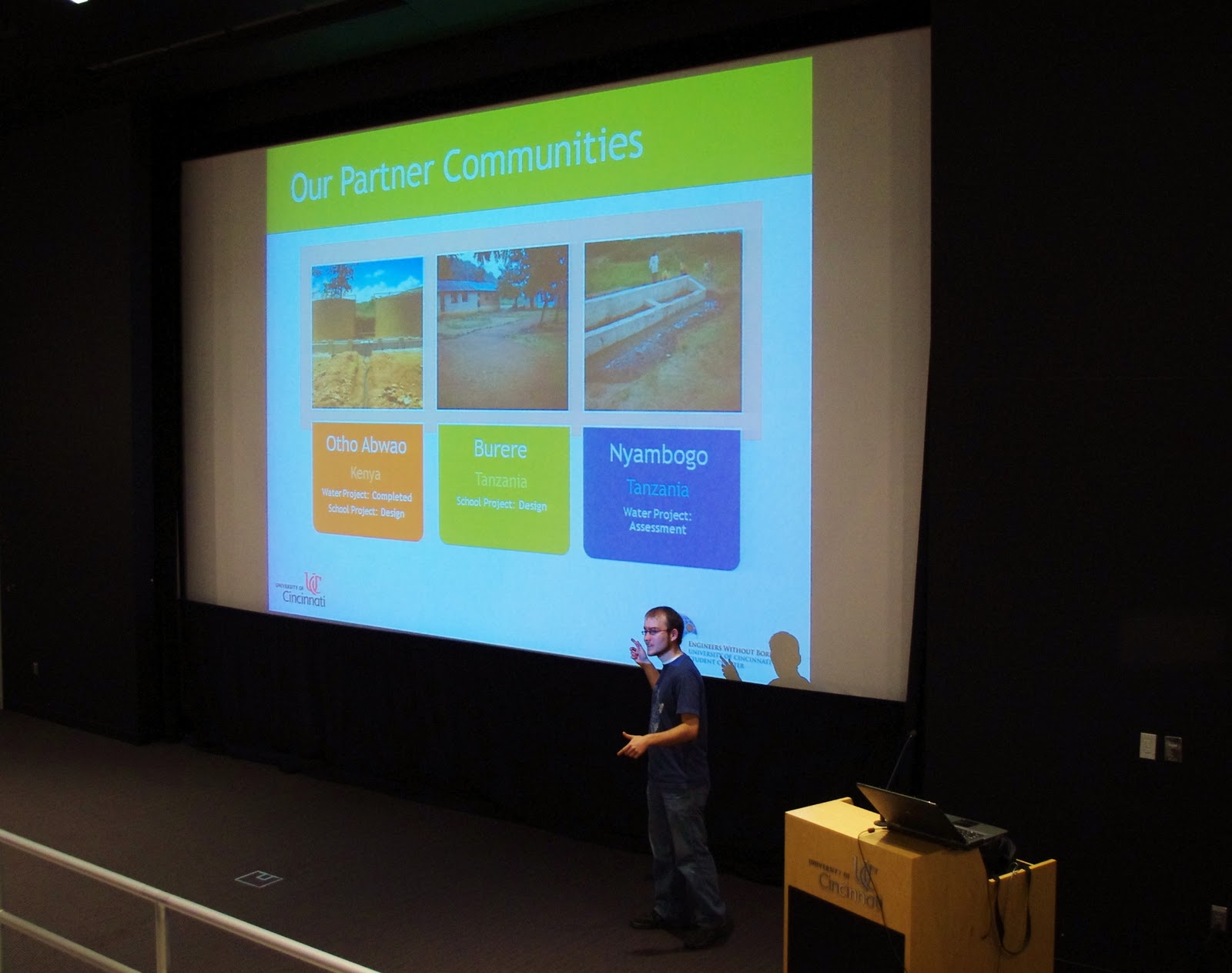
Cincinnati Children's had a conference on Global Health and EWB was invited to speak on building community partnerships. In our talk, we focused on a series of steps to building a solid partnership based on our experience. They are...
- Make a Good First Impression: know the culture and get to know the people
- Identifying Stakeholders: start meeting the people in the community with influence
- Establishing Roles: create roles like a community contact or decision making committee
- Setting Partnership Terms: agree on areas like funding and community contribution
- Reinforce Roles: train people for their roles and show the rest of the community who the role-members are
- Maintaining Communication: even between trips, keep a steady flow of communication
- Revision and Reaction: constantly evaluate and tweak decisions based on how things are going.
 |
| At the Cincinnati Children's Global Health Conference |
Thursday, April 1, 2010
Otho Abwao Assessment: Productive & Fun

There was plenty of fun too, from a soccer game vs. the school's all-star team during a rainstorm, to navigating the markets in Nairobi. It was a blast!
Again, look for lots more about the trip once our team(me included) shakes off their jetlag and can actually process this amazing experience.
Tuesday, May 12, 2009
Messages of Thanks From the Community
We received emails from the community with notes of thanks:
TITLE: WATER IS LIFE IN OTHO ABWAO KENYA AFRICA
I would very much on behalf of my community: Otho Abwao, Nyando District, Kenya, Africa give our gratitude to the students of Cincinnati university for making it possible for us to have a running water in our community. Our ladies who were tired of stepping on the foot pump which was very hard for the old ladies to pump water can now fill their 20litres jerry cans within a minute. Thanks to EWB Cincinatti, Prof. Dan and the entire team who ventured in Kenya, Africa to let us have clean drinking and cooking water. Thanks so much. We hope our partnership will keep on and you will be back!!!!! Thanks and God bless your organization.
Hazel Okullo
-------------------------------------------
Hi Andy and colleagues,
Hope your journey back to the states was fine. How are you doing? Once again on the behalf of the community and my own behalf register our appreciation for the excellent work your group did for us. It is our prayer that may God continue to bless you as you continue to study and in helping the less fortunate. We look forward to hear from you and see you once again. Say hi to the rest
Kind regards
Seth Oluoch
Sunday, March 29, 2009
Today they got water from a tap

Friends,
This is your EWB President, Andy Schriner, having just returned from Kenya from our first ever trip to implement a project. This project was the water distribution system for the ~500 people of the Otho Abwao community in southwestern Kenya, who previously relied on a very laborious foot pump for their only source of clean drinking water. Now, thanks to the solar panels, electric pump, two storage tanks, several kilometers of pipe, and 5 water access kiosks EWB installed, the people of Otho Abwao can get water in less time with less effort, which we expect will improve health in the community, improve school attendance as children are freed from the burden of collecting water, and create more time for community members to engage in valuable economic activity and move themselves up the ladder out of poverty.
There are a lot of angles to take on this momentous occasion. I'll start with a brief recap of the trip, then I'll throw in some of my reactions and experiences, and then I'll try to put this into the context of my personal journey with EWB. You can look forward to blog posts from the other travelers in the near future.
The team of six students consisting of myself, Emily Stover, Neil Schaner, Liesbet Michiels, Kevin Knollman, and Jordan Vogt, and our wonderful faculty mentor Dr. Dan Oerther, arrived in Nairobi on the night of Sunday, 3/15. The additional team members of Mike Morarity and Ely Dixon were scheduled to arrive four days later on 3/19. On Monday, 3/16, we drove to Otho Abwao, arriving in the evening, excited to find two large ferrocement tanks built by Nelson Amolo, a local contractor, where before there was just a field. Most of our materials arrived on a truck the next day, and over the next several days we worked together with the water technicians the community had chosen to get the pipes laid, connections made, and kiosks installed. Emily was able to conduct health surveys in a number of households, even more than she had anticipated. There was something of a snag in the construction process, though: the pump and 2 of 7 solar panels were held up at the Nairobi airport in customs due to a tax issue with the vendor. We worked to finish as much as we could without those key parts, and by Saturday it was decided that someone needed to stay longer than originally planned to supervise the installation of the pump and panels. Dan, being the dedicated professional he is, volunteered, saying he thought it best that he be the only one to stay to fit the last pieces into the puzzle. With everyone agreeing that Dan was more than capable of finishing the job solo, arrangements were made for him to stay through the rest of the next week. On, Sunday, 3/22, the last full day before we left Otho Abwao, we held a community meeting during which we discussed the importance of the community's taking ownership of the system, not making changes or additions to the pipe network, and not using water extravagantly, and during which the water technicians explained the system to the community in their own language. Ely was scheduled to carry out the health education programs for the school children and adults on Monday, 3/23, and she and Mike were scheduled to travel across the border to Tanzania later that week to collect information for future EWB projects there. Also on Monday was the planned departure of the first team from Otho Abwao; the six students said their goodbyes and set off, with Dan accompanying so that he could personally ensure the procurement of the missing pump and solars panels in Nairobi. On Wednesday, 3/25, Dan sent a text message to the US, saying, "We have water!" (meaning the pump had been installed and the tanks were being filled). By this time the remaining members of the travel team are making their way back to the US, and we can all look forward to their additional updates.

In terms of my reactions and experiences, there are all kinds of things I could say. I don't think there's a good way to organize everything, so here's a list in no particular order:
- I've certainly learned a great deal from this experience, with no small amount of the learning coming from my own mistakes. Some say that's what mistakes are for, and while I certainly will make use of my mistakes for their educational value, at the same time it's still frustrating to have things not go as well as they otherwise could have. Ah, such is life.
- "TIA" - We throw this phrase around a lot in EWB. If you've seen the movie Blood Diamond or been around EWB much, you might know that it stands for "This Is Africa". It basically means that things in Africa don't really work the same way we expect them to in the West. Like the solar panels and pump being stuck in the airport in customs for the entire duration of our planned stay in Otho Abwao. Like when someone asks at 2:30 pm when the driver will be back from town with our drinking water, seeing as how we are completely out and are working on the equator, and the driver says one hour, and isn't back till 5:30 pm. Also, like when a newly trained and empowered water technician offers to give you a small hen to remember him by. Or when an old "mama" grabs you genially by the wrist, and through a translator, inquires as to whether your mother is still alive, and when hearing the answer is yes, asks you to say hello for her. I'm just barely scratching the surface here. Dan could probably write a book called TIA.
- Speaking of the water technicians: I was caught a little off guard by the level of engagement and understanding and quality of questions they were asking. It was an excellent surprise.
- Two words: camp shower.
- I think it should probably be noted that the fact that one of Kenya's official languages is English is a huge help in our work. That means we can communicate directly with the technicians, and when we do need a translator for Kiswahili or Luo, there are translators all around.
- I don't think the relationship with the community as partner and customer was emphasized enough throughout this whole process. Sometimes it's too easy for designers to go off behind closed doors (or "behind" 8000 miles of physical separation) and create something, in this case a water distribution design, that fits into their ideas and expectations of the context of use. What we forget, and what I learned to a greater extent on this trip, was that people will live their lives the best way they know how, and if that means using a designed object in a way different from what the designer intended, then so be it. I don't think this particular design will be used in a way that is wildly different from the intention of the particular designers (i.e. the students of EWB), but perhaps with a greater emphasis on collaboration, the experiences and knowledge of the community members could have helped guide the design to a higher level of overall quality.
- Working on a very tight schedule, in a different culture and a very different place, doing a task with which you have no previous experience as things change and go wrong, while living, working and eating with your colleagues, is exhausting. Make no joke about it.
- I think all of us who traveled were looking forward to seeing the moment with our own eyes when the people of Otho Abwao first drew water from the new system. I think we were all likewise a little disappointed to have to leave before seeing that. We have to keep in mind, however, that we're not in this for the feel-good photo op. We're in this to make a difference - and that's what we've done. At the same time, I'm very happy for Dan that he had the opportunity to see that moment.
- 500 people in Kenya now have much easier access to clean drinking water thanks to the hard work and support of many, many people. Thanks to you all - you've done a good work.

Lastly, and I know this is turning into a novel...
It's a strange feeling to be where I am now, having co-founded this chapter of EWB at UC some four years ago, having participated as an engineer in the design of this project, having worked as President to put all of the various other pieces in place to make this project successful, and now having just returned from the implementation trip that marks the first tangible step that this organization has made to fulfill its mission of improving quality of life for those in developing communities. A part of me wants to make a neat, tidy conclusion out of it. It's done, right? Water is flowing. But to do that would be to miss the point of what EWB does, and what makes EWB different from other aid organizations. For us, the Otho Abwao water project has just begun. We have health monitoring to continue; we have school attendance records to check to see if more kids are attending. We have to support our partners there in the operations and maintenance of their system. We have to check back and see how they are using it, how it's affected their community, and how we can do things better in the future. We have to do things better in the future on new projects. There's a great deal of work left to do. I hope you'll continue with me on the journey.

Subscribe to:
Posts (Atom)